
 MaterialLithiumView details
  PRODUCT PHOTO / PROVISIONAL
01 Rare metals
Rubidium.
Technical information on Rubidium. Material data and supply forms on request.
Inquire about product02 Product information
Details on
Rubidium.
| Product name: | metallic |
Guest |
TU 95.42-92 TU 1717-055-00194530-96 |
Rubidium, its properties and alloys
| Atomic mass | 85,47 |
| Density, g/cm3 | 1,532 |
| Temperature, °C: | |
| melting | 38, 5 |
| boiling | 705 |
| Specific electrical resistance, mcom . see | 11, 6 |
| Coefficient of thermal conductivity, cal/ (see sec. grad) | 0, 075 |
| Linear expansion coefficient, 1/degree | 90.10-6 |
| Specific heat capacity, cal / (g. grad) | 0,0913 |
| Hidden heat of melting, cal/g | 6,1 |
rubidium - soft metal with low density and low melting point. Pure rubidium has a silvery white color. Rubidium is chemically similar to potassium and is active from all stable elements found in nature in the form of certain compounds. Rubidium interacts very actively with water. The reaction of water decomposition proceeds with great speed and is accompanied by ignition. High activity of rubidium with oxygen and nitrogen is used in the manufacture of radio lamps to create a high vacuum in them.
Rubidium interacts with glass, which, when heated to 300 ° C, quickly breaks down with the release of elemental silicon. This metal interacts vigorously with halogens, sulfur and phosphorus, with iodine the reaction occurs when heated, with other nonmetals the reaction proceeds with ignition, and with bromine - with explosion.
Rubidium is light-sensitive and easily ionized by visible, infrared and ultraviolet regions of the light spectrum. Rubidium alloys with antimony, bismuth and other elements are characterized by the loss of electrons under the action of light, which allows it to be used in photocells.
Scope:
in the electronic and lighting industry
Mass fraction of Rubidium - at least 99.9%
Mass fraction of impurities. Rubidia (Rb), Sodium (Na), and Potassium (K). %, no more than-0.01
Tara at the pack:
stainless steel container with a volume of 7 liters, net weight of 10 kg in argon environment;
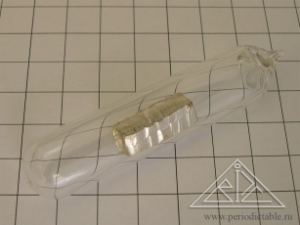
in glass ampoules of borosilicate glass weighing from 1 to 100 g or capillary glass ampoules from 1 to 200 mg.
In electrical engineering, rubidium is used in the production of luminous tubes, and is also introduced into the composition of fluorescent substances used in the manufacture of luminous discharge tubes. In X-ray technology, rubidium compounds are used to increase the adsorption of X-rays by screens from ZnS. The light ionizability of rubidium makes it possible to use it in devices and installations associated with the direct conversion of heat into electrical energy, ion engines, thermoelectric generators.
Metallic rubidium is used as a catalyst for the hydrogenation reaction of benzene as well as other aromatic hydrocarbons and in polymerization reactions in the production of synthetic rubber. Rubidium compounds are also used in medicine.
Important for sourcingPurity, form, quantity and timing help us assess your inquiry.
03 More materials
Also of interest.
04 Inquiry
Your material.
Your specification.
Tell us the required purity, form and quantity so we can assess your request.