
 MaterialZincView details
  PRODUCT PHOTO / PROVISIONAL
01 Non-ferrous metals
Babbitt alloys.
Technical information on Babbitt alloys. Material data and supply forms on request.
Inquire about product02 Product information
Details on
Babbitt alloys.
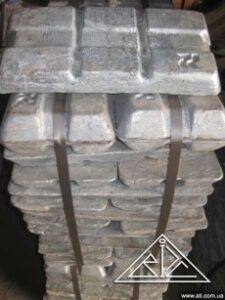
Babbit is an antifriction alloy based on tin or lead, intended for use in the form of a layer poured or sprayed on the body of the bearing liner.
The most common alloy options:
- 90% tin, 10% copper;
- 89% tin, 7% antimony, 4% copper;
- 80% lead, 15% antimony, 5% tin;
As additives can be used: antimony, copper, nickel, arsenic, cadmium, tellurium, calcium, sodium, magnesium.
Melting point — 300—440 °C.
The first bearing alloy was developed by the American Isaac Babbit in 1839.
Babbit, which is based on tin (B88, B83, B83C, SAE11, SAE12, ASTM2), is used when the antifriction material requires increased viscosity and a minimum coefficient of friction. Tin babbit compared to lead has higher corrosion resistance, wear resistance and thermal conductivity.
Lead-based Babbits (B16, BN, BSB, BKA, BK2, BK2Sh, SAE13, SAE14, ASTM7, SAE15, ASTM15) have a higher operating temperature than tin-based. It is used for bearings of diesel engines, rolling mills.
Lead-calcium babbit It is used in bearings of rolling stock of railway transport.
All babbits have a significant drawback - low fatigue resistance, which worsens the performance of the bearing. Due to the small strength of babbits can be successfully operated only in bearings with a strong steel (iron) or bronze body. Usually, thin-walled bearing liners of automobile engines are made by stamping from bimetallic tape obtained on the continuous pouring line. The duration of bearings depends on the thickness of the babbit layer poured on the steel liner. Reducing the thickness of the layer increases the life of the bearing.
Important for sourcingPurity, form, quantity and timing help us assess your inquiry.
03 More materials
Also of interest.

04 Inquiry
Your material.
Your specification.
Tell us the required purity, form and quantity so we can assess your request.