
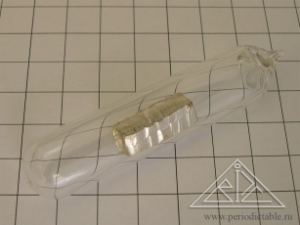
 MaterialLithiumView details
 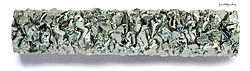 PRODUCT PHOTO / PROVISIONAL
01 Rare metals
Hafnium.
Technical information on Hafnium. Material data and supply forms on request.
Inquire about product02 Product information
Details on
Hafnium.
Hafnium iodide (RETU 119-59) produce three brands: GFI-1 (not less than 99.93% Hf + Zr), GFI-2 (99.7%) and GFI-3 (99.6%) zirconium content for all brands not more than 0.1%.
hafnium powder (RETU 854-61) produce three brands: GPM-1, GPM-2 and GPM, differ in the content of the basic substance.
According to semiconductor properties, several groups are produced - I, II and III (RETU 1221-64), which by type of conductivity are divided into types: n-type with electron and p-type with hole conductivity.
Application
The main areas of application of metal hafnium are the production of alloys for aerospace technology, nuclear industry, special optics.
In nuclear engineering, the ability of hafnium to capture neutrons is used, and its application in the nuclear industry is the production of regulatory rods, special ceramics and glass (oxide, carbide, boride, oxocarbide, dysprosium gafnate, lithium gafnate). A feature and advantage of hafnium diboride is very small gas production (helium, hydrogen) during the "burnout" of boron.
In optics, hafnium oxide is used due to its temperature resistance (i.e., 2780 ° C) and a very high refractive index. A significant area of consumption of hafnium is the production of special brands of glass for fiber-optic products, as well as for obtaining especially high-quality optical products, coating mirrors, including for night vision devices, thermal imagers. Hafnium fluoride has a similar application.
Carbide and boride hafnium 3250 °C are used as extremely wear-resistant coatings and the production of superhard alloys. In addition, hafnium carbide is one of the most refractory compounds (i.e., 3960 °C) and is used for the production of space rocket nozzles and some structural elements of gas-phase nuclear jet engines.
Hafnium is distinguished by a relatively low electron yield (3.53 eV), and therefore it is used to make cathodes of powerful radio lamps and electronic guns. At the same time, this quality, along with its high melting point, allows the use of hafnium for the production of electrodes for welding metals in argon and especially electrodes (cathodes) for welding low-carbon steel in carbon dioxide. The resistance of such electrodes in carbon dioxide is more than 3.7 times higher than tungsten. Barium hafnate is also used as effective cathodes with low yield work.
Important for sourcingPurity, form, quantity and timing help us assess your inquiry.
03 More materials
Also of interest.
04 Inquiry
Your material.
Your specification.
Tell us the required purity, form and quantity so we can assess your request.