
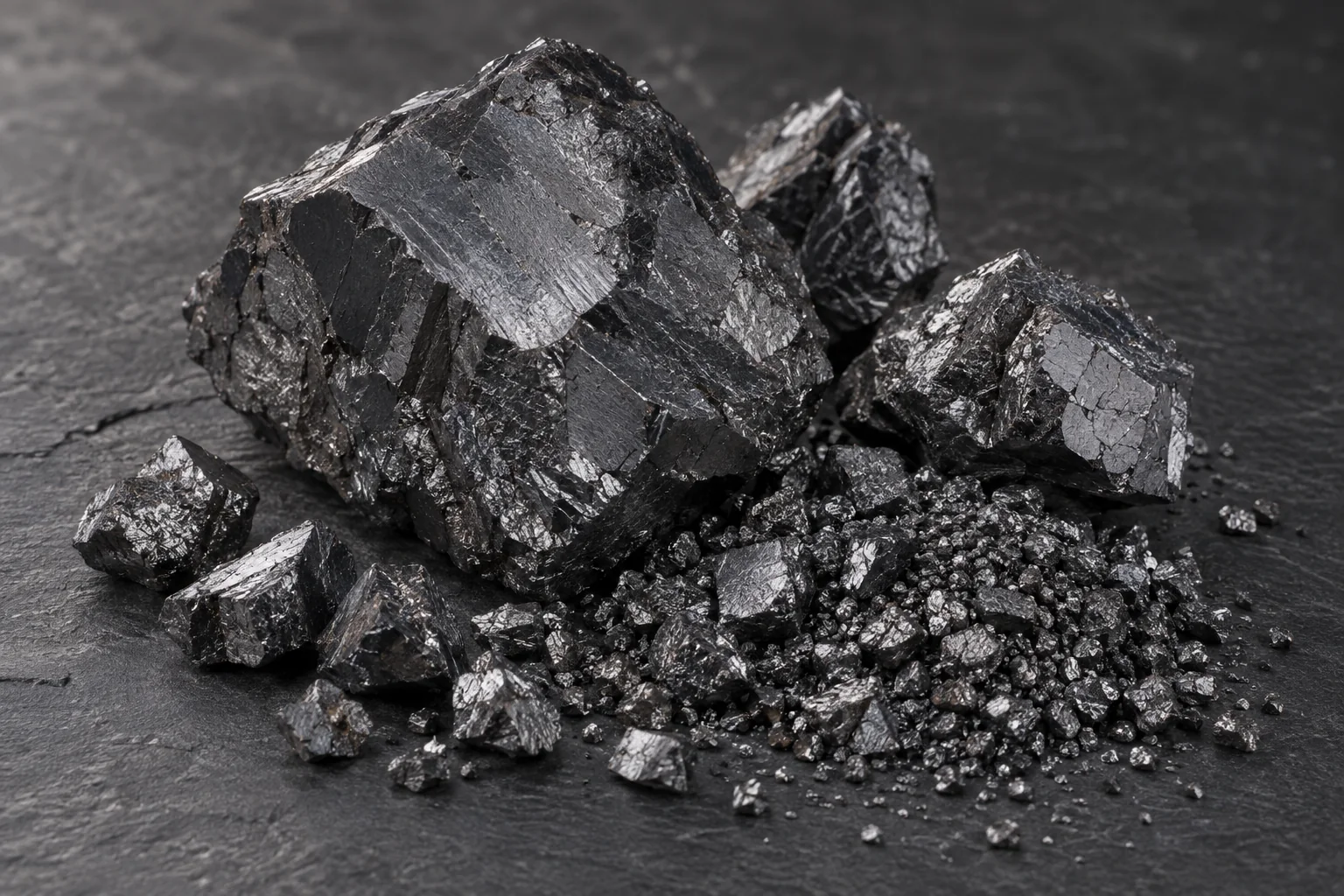
 SELENIUM / ILLUSTRATION
01 Rare materials
Selenium.
An uncommon element with distinctive properties. Grey selenium responds electrically to light and has a place in several industrial processes.
Chemically, selenium is a non-metal. In this range it sits alongside rare technical materials. Purity, form and composition determine the right grade for a specific application.
Inquire about selenium02 The material
Small in quantity.
Big in function.
Selenium occurs naturally in small amounts and often accompanies sulfur-bearing ores. Industrial production commonly recovers it as a by-product of copper refining. Depending on its structure, it may appear red, black or metallic grey. The grey crystalline form is the most stable.
Its photoconductivity is particularly distinctive: light changes the electrical conductivity of grey selenium. This property made it useful in photoelectric cells and traditional copying technology. Applications also include special glass, ceramic pigments and selected metallurgical additives.
03 Material data
Technical
information.
Indicative values for elemental grey selenium. Agreed product documents govern any delivery.
- Symbol
- Se
- Atomic number
- 34
- Relative atomic mass
- 78.971
- Element group
- 16 · Chalcogens
- Density
- approx. 4.81 g/cm³
- Melting point
- approx. 220.8 °C
- Boiling point
- approx. 685 °C
- Purity / form
- On request
Reference values: Royal Society of Chemistry. Values may vary by allotrope and measurement conditions.
04 Applications
One element.
Many functions.
The application shapes requirements for purity, particle size and composition. Three common fields show the range.
Photoconductive technology
Grey selenium changes conductivity when exposed to light. Its semiconductor properties have been used in photocells, rectifiers and traditional copying systems.
Control color
Selenium compounds can decolorize glass or produce red tones. Ceramic glazes and pigments are further established applications.
Modify alloys
As an additive, selenium can influence selected metal alloys. The required composition depends on the process and final product.
05 Your specification
Three details.
A clear start.
A useful material inquiry describes the intended application and its technical needs.
Purity
Which minimum grade is needed? Include limits for relevant impurities.
Form
Do you need powder, granules or another form? Include desired dimensions.
Quantity
Share expected demand, timing and any repeat orders.
07 Product data
Further technical details.
| Product name: | selenium selenium |
Atomic number |
34 78,96 4790 217 685 0,352 2,5 1,16 9,75 |
Selenium distribution in nature. Selenium is a very rare and scattered element, its content in the earth's crust (clark) is 5×10⁻⁶% by mass. The history of Selene in the Earth’s crust is closely related to the history of sulfur. Selenium has the ability to concentrate and, despite its low clark, forms 38 independent minerals - natural selenides, selenites, selenates and others. Characterized isomorphic impurities of selenium in sulfides and native sulfur.
Application
The main consumers of selenium are electronics, ceramics and dyes, and the steel industry.
Electronics
For electronics, selenium is made of plates of electric rectifiers, xerographic plates, photocells, solar panels and television cameras. In all cases, selenium is required with a degree of purity of 99.99-99.999%.
Selenium straighteners. The dry selenium rectifier consists of a sandblasted substrate or an etched iron or aluminum plate coated with nickel or a thin bismuth layer and a 0.50-0.75 mm thick selenium layer. The selenium layer is applied by evaporation in a vacuum chamber or first coated with selenium powder, which is then compressed for several minutes under a hydraulic press with heated plates. The resulting "sandwich" is subjected to heat treatment for 30 minutes at a temperature slightly above 210 *. Then create an artificial barrier to increase the resistance of the device when the current passes in the opposite direction. Finally, a balancing electrode is installed from the By alloy of another metal and a selenium rectifier is included in the electrical circuit to bring and improve the locking resistance. The discs are collected in industrial appliances, which are immersed in insulating varnish and packaged for shipment.
Glass and ceramic industry
07 Inquiry
Selenium for
your project?
Tell us the purity, form and quantity you need.